Book of Knowledge
FALL
Law[s]
In a Sapere Aude reading, “Invitation to Law and Society, An Introduction to the Study of Real Law” defines law as “a written set of rules governing society.” Robert Cover, in ‘Nomos and Narrative’, describes law to be a form of “social control” while acknowledging that it is a set of rules [7]. It is crucial to remember that in Cover’s definition, the ones approving laws are those in government who enforce their perspective as universal, and the ones upholding them are the judges in legal spheres.
Cover’s concern with the word law is with how it embodies and shapes our lived reality [6]. Laws are not enacted within a vacuum; they are “determined by our interpretive commitments and norms” [4]. The creation and enactment of a law itself by the government is a “bridge linking a concept of reality to an imagined alternative” [6]. Once the vision for society is brought to life, the collective narrative/reality of that society is expected to shift into that ideal [6].
Law, as Cover mentions, tends to place one ideal for society “in the highlight of insistent and immediate demand while casting another part in the shadow of the millennium” [6]. The people of that society then determine the worth of the law depending on their personal lives, morals, and upbringing [4]. It is not uncommon that government ideals for society and citizen narratives clash, leading to legal disputes and civil disobedience. It is also not uncommon for citizens to seek protection from these laws and follow the law despite not agreeing with the law [3].
This semester, we read “The Ones Who Walk Away From Omelas” by Ursula K. LeGuin, a piece of work that puts into perspective Cover’s definition of law. In Omelas, the law of society is placed within a utilitarian point of view, as one child is a sacrificial lamb. The child is hidden in a basement, in misery and decline, for the rest of society’s happiness. There are almost no other laws for the Omelas society except for one restriction: never to speak to the child [4]. This law is a form of social control for those in Omelas and prevents them from acting against it in fear that they’ll disrupt their collective shared reality.
History
In his book ‘Silencing the Past,’ Michel-Rolph Trillioulliot defines history as “both the facts of the matter and a narrative of those facts” [4]. Through the double entendre, he emphasizes that history has two active participants: the real scheme of events and the retelling of what happened.
Sylvia Tamale, in her work ‘Decolonization and Afro-Feminism,’ uses the word ‘history’ in a similar way, illuminating that “every object, concept, and individual has a history” [7]. She deems it essential to acknowledge the actual workings of past events, how they are retold, and how they affect the future archival of that event. Tamale and Trillioulliot utilize the meaning of history to shine a light on previous acts of terror committed in the past, such as colonialism and the African apartheid. Their connection is that those in power, the colonists, used the power of language to completely change the narratives of the indigenous people. That is the “told” history versus the “real history” [Tamale, 9].
Cultural Relevatism
In her work, ‘Decolonization and Afro-Feminism,’ Sylvia Tamale lists the definition of cultural relativism as “the idea that the standards of treaty-based human rights are not universal” and must be shaped in accordance with the society that created them (5). By “not universal,” she explains that different cultures around the world have different ways they live their lives. They have different laws and cultural norms that prevent them from all being monolithic and hegemonic (the same). Therefore, it is impossible to subscribe to one way of life for all cultures, especially outside the Americas.
The context for her use of “cultural relativism” comes from the notion of “decolonizing the mind” and learning how colonization affected the colonized and their ways of life [8]. It is important to see how colonialism oppressed the indigenous people by becoming knowledgeable on the “cultural systems” that came before it [8].
Memoralization
Martina Sturken defines memorialization in ‘Cultural Memory in the Wake of Violence..’ as being “inherently about inclusion and exclusion” [64]. Memorials are man-made objects or acts created to honor and remember a certain person/event. Sturkey argues that at its core, memorials “represent” certain groups of people, but leave out others [64]. As an example, the Vietnam Veterans Memorial and the statue of the 3 male soldiers next to it do not depict women or Korean War veterans [64].
Due to this, Sturken believes the act of memorialization itself is inherently political [65]. It is connected to how societies resolve conflict and move forward with wars and tragic events, playing into “cultural memory” [65]. Sturken defines “cultural memory” as collective memories that a group of people shares about certain events [65]. Memorialization plays a part in how “cultural memory” often “functions to define events within a particular time frame, with political consequence” [67]. However, memorialization also “often participates in designating distinctions of the dead into, for instance, victims and perpetrators, the named and unnamed, and the innocent and the complicit” [69]. The greater use for memorialization is a future with no “[perpetual] cycles of revenge and retaliation” and, in doing that, sometimes it “crowds out other potentially equally important memories of trauma” [64].
Free Man
John Locke in his work, “Two Treatises of Government” defined the concept of a “free man” as the “state all men are naturally in, and that is, a state of perfect freedom to order their actions, and dispose of their possessions and persons, as they think fit, within the bounds of the law of nature, without asking leave, or depending upon the will of any other man” (Ch. 2). Locke theorized that everyone is naturally born free and equal with the opportunity to make free choices, unless they agree to be in a society, where they now have to consensually “put on the bonds of civil society.” Putting on the bonds of civil society refers to the idea of giving up parts of your freedom to function as a group of individuals with aligned goals [Ch. 8].
Moral
Morals are rules societies create that deem what is “wrong” or “right in that society. Peter Singer, in “Famine, Affluence, and Morality,” describes morals as “shaped by the needs of society” [236]. In accordance with having a moral code, Singer cites Sidgwick and Urmson to emphasize that morals must be “not too far beyond the capacities of the ordinary man” [237]. Together, both quotes focus on morals being societal rules of what is right and wrong, and within the capabilities of human beings. It aligns with Robert’s Cover usage of the word “moral” as “every narrative” having the word morals [5]. Every narrative, as in every world and society.
In addition, the “The Old Education and the Think-Academy” chapter of Martha C. Nussbaum’s book ‘Cultivating Humanity…’ describes an open, expanded moral imagination as “educated citizens learning a lot of facts and mastering techniques of reasoning” [27]. That way, they’ll be “capable of love and imagination” and stay open-minded when it comes to understanding people who aren’t like them [27].
Body
Cynthia J. Novade, in her book “The Body’s Endeavors as Cultural Practices,” defines a body to be a “biological absolute, a purely physical reality (sometimes with emotion and desire attached)” [180]. She ties the idea of the body into lived experiences, specifying that bodies, although all physical, are perceived differently by others. Different bodies convey different meanings; therefore, it is crucial to remember whose body is being talked about [180]. However, as expressed in the passage, most Americans think of the body as separate from the mind, but the body is a “language” of itself that can convey meaning [181].
Narrative
Robert Cover describes narrative as a world we inhabit with rules and ideals of how it should be [5]. He elaborates that our narratives are connected to our “normative system” (whats normal for us) and our “social constructions of reality” [7]. Narratives can be a collective societal experience, or our personal narrative being our own world [15]. In narratives, there are “rules” in the form of law, as “law and narrative are inseparably related” [5]. However, everyone’s personal relation and interpretation to the laws depends on our “own personal commitments” and upbringing [4].
A good example of narrative affecting law is “the Constitution of the United States: Contemporary Ratification” by Brennan. Brennan states that he has a very public relation to the way he interprets the Constitution as a Supreme Justice [2]. His personal commitment is being a public figure, a judge, therefore he views his interpretation of the Constitution to be important and life changing. He has the power to affect other people’s narratives based on his own narrative and interpretation [4].
SPRING
Cheap
A History of the World in Seven Cheap Things by Raj Patel and Jason W. Moore applied the already existing meaning of cheap, something perceived to be low in price, as a way to explain the set of strategies capitalism has employed to control all aspects of our lives in a rigid manner. Capitalism likes to “invest as little and profit as much as possible” [21]. To call something cheap, in this regard, is to describe a violent system that devalues work, care, life, energy, and nature by exploiting it and giving little to no compensation in return [Moore; Patel, 3, 4, 22]. It is explained, “capitalism thrives not by destroying natures, but by putting them to work – as cheaply as possible,” [19] An example given was the domestic labor, care work, and community intensive support the women in the Brazilian sugar industry had to do despite being worth less than men. Here, capitalism defined whose lives mattered were worth more than others, and how “care” in this instance was exploitation cheaply. These strategies are often employed “at the expense of women, the colonized, the poor, people of color, and immigrants,” all which are marginalized communities [5].
The documentary 13th clearly conveys what cheap lives mean at the hands of capitalism. In the documentary, it is highlighted how the United States prison population is 2.3million as of 2020, winning out all other countries as the one with the highest rate of incarceration. The highest incarcerated population is the black population, which has been targeted since slavery was abolished as of 1865. To maintain control over the black population, the United States has declared “war” on drugs and terror to further incarcerate black individuals and capitalize off their labor. Black individuals can’t choose to not be incarcerated, and the institutional foundation of prison treats their lives as cheap and fungible, something to be exploited for private company gain. Cheap lives, in this context, is the reduction of the importance of black life.
Reparations
Time for Reparations by Jacqueline Bhabha, Margareta Matche, and Caroline Elkins imply reparations to be compensations for wrong doings such as slavery, colonization, systemic discrimination, and so forth. Reparations are ways of “preventing ongoing and future injustice,” however, they are “highly contested” (2). Much of the controversy surrounding reparations stems from the fact that descendents of “surviving populations or successor governments of atrocities” and “heirs of victims” do not want to continue the “legacy of past harm” by demanding reparations (2). Reparations come in the form of wealth or land distributions given by the government, and that in itself challenges the capitalist modern “status quo” (3). Hence, reparations are frequently denied despite being a key factor to preventing future injustice, rather than reopening past wounds or “put two communities against one another” (5).
Nancy Fraser in Rethinking Recognition argues that recognition, without material retribution to sustain the apology, is not enough to count as a meaningful reparation. The overall decline in distributive reparations can be blamed on the “neoliberal rhetorical assault” on egalitarianism, an overall decline on the push for equality in favor of capitalistic ideologies like personal success and market equality [108]. Fraser asserts that the globalization of capitalism only increases, further pushing economic inequality that recognition alone cannot materially sustain marginalized communities. The reparation in that sense, loses its meaning as a compensation for historical wrongdoing as it continues to perpetuate the ongoing inequalities and “eclipse” them (108). Although Fraser does try to reconstruct recognition as a form of preparation with additional meaningful material components, I focus on her initial critique of recognition.
Authenticity
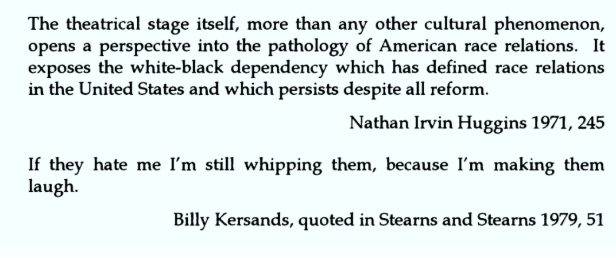
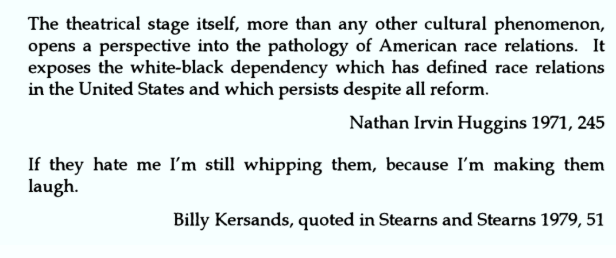
Brenda Dixon Gottschild explored the term “authenticity” in Digging the Africanist Presence through blackface minstrelsy and performance. Authenticity is not explicitly defined; it shows up when white and black minstrel performers wanted to come across as “authentic” depictions of African Americans that were not real depictions of them, but instead mischaracterizations that were “childish, ignorant, and oversexed” (83). Authenticity in this sense was the real distortion of enslaved African Americans for entertainment purposes, and led to their own internal struggle of identity formation (85). Between being ridiculed and newly freed black individuals entering the minstrelsy stage, African Americans felt that minstrelsy allowed them to have the “freedom to be ridiculous” while simultaneously losing themselves to a persona (84). Authenticity becomes contradictory because minstrel performances were treated as “real” depictions of African Americans, but they were all mischaracterized caricatures.
In Ethnic Notions by Marlon Riggs, he lists the mammy, pickaninny, coon, sambo, and uncle as racist caricatures that dominated the 20th century. The issue with all these caricatures, though, is that none of them are real, authentic depictions of black individuals, but instead personas made to make a mockery of them. All personas adopted by white and black minstrels alike only further pushed the disconnect between accurate perceptions of African Americans and a happy and giggly enslaved individual serving their master. As a result, all black features in caricatures were promoted as ugly, grotesque, and anti-civilized, while white features were uplifted, and therefore, the black body was further diminished. Through these texts, I understand how authenticity can be distorted and socially constructed through performance and representation.
Authenticity
The term “authenticity” is explored in the work Digging the Africanist Presence by Brenda Dixon Gottschild through blackface minstrelsy and performance. Authenticity is not explicitly defined, however it shows up when white and black minstrel performers wanted to come across as “authentic” depictions of African Americans that were not real depictions of them, but instead mischaracterizations that were “childish, ignorant, and oversexed” (83). Authenticity in this sense, was the real distortion of enslaved African Americans for entertainment purposes, and led to their own internal struggle of identity formation (85). Between being ridiculed and newly black freed individuals entering the minstrelsy stage, African Americans felt that minstrelsy allowed them to have the “freedom to be ridiculous” while simultaneously losing themselves to a persona (84). Authenticity becomes contradictory because minstrel performances were treated as “real” depictions of African Americans, but they were all mischaracterized caricatures.
In Ethnic Notions by Marlon Riggs, he lists the mammy, pickaninny, coon, sambo, and uncle, as racist caricatures that dominated the 20th century. The issue with all these caricatures, though, is that none of them are real, authentic depictions of black individuals, but instead personas made to make a mockery of them. All personas adopted by white and black minstrels alike only further pushed the disconnect between accurate perceptions of African Americans and a happy and giggly enslaved individual serving their master. As an effect, all black features in caricatures were promoted as ugly, grotesque, and anti-civilized while white features were uplifted and therefore the black body was further diminished. Through these texts, I understand how authenticity can be distorted, and socially constructed through performance and representation.
Choreopolitical
The word choreopolitical, as introduced in Choreopolice and Choreopolitics: or, the task of the dancer by André Lepecki refers to the ability of moving bodies to utilize movement as a method of resistance against systems that surveil and discipline bodily movement. Lepecki references Hannah Arendt’s observation that society “[doesn’t] know how to move politically yet” and as a result they are unable to find “sense, meaning, and orientation, in moving freely” (14). Freedom is an embodied experience and “antipolitical affects and relations are permanently being inscribed and re-inscribed within subjectivity itself.. [and it becomes] the new, consensual norm” (15). Therefore, the body submits to social standards instead of embodying freedom. Arendt’s use of the word political is deeply bound to freedom and people’s inability to move however they want comes from an institutionalization of surveillance (15). The surveillance structure, both social and physical, forces bodies to conform to societal standards of movement and acceptance (15).
In Choreographies of Protest by Susan Leigh Foster, choreopolitics becomes apparent by the die-ins performed by the AIDS Coalition, ACT UP. As expressed by Foster, AIDS support was a very controversial topic and the stigmatization led to the marginalization of the queer, black, and other people of color communities. In retaliation, ACT UPers “[exerted] a passive noncompliance” by lying completely still, requiring police to “coordinate the removal of each body” (404). It is within society’s acceptable standards that people do not lay on the ground in public, especially on a busy street like Wall Street, but ACT UPers broke the flow of public space as an act of resistance. The die-ins protests align with André Lepecki’s idea of choreopolitics since ACT UPers explored a particular political movement to defy stigma surrounding illness and lack of visibility.
State of Exception
The state of exception, as defined by Giorgio Agamben in The State of Exception, is an ambiguous “intersection of the legal and political” that blurs civil war, martial law and domestic policing (1-2, 4). When the United States declares a national crisis, they start to implement “military order” laws while “[suspending] normal legal protections” (3). These policies emerge during a “temporary political crisis,” under the assumption that the laws will be revoked once the crisis is over. Agamben argues that society never returns to its previous normal state. Instead it becomes a normalized ambiguous state that affects everyday life, and policing stays extreme (2-3, 6). The effect is an increasingly militarized domestic policing.
The state of exception can be seen through The New Jim Crow by Michelle Alexander, where she argues the ‘War on Drugs’ was a crisis that sparked the “state of exception” as policies expanded traditional domestic ways of criminalization meant to crack down on the spread of crack cocaine [2/8]. There was increased surveillance and criminalization within black communities as law enforcement was blocked from investigating “illegal drug networks helping to fund its war in Nicaragua” [⅜]. Even as the spread crack started to die down, the increased policing and surveillance remained with the stigma that surrounded black communities.
Civil contract
In The Civil Contract of Photography, Ariella Azoulay defines the “civil contract of photography” as a political relationship between the photographer, the photographed, and the spectator (88). Azoulay argues that photography is not only the photographer’s property, it is also the property of all the individuals connected to the work. Therefore, photography is “no one’s property” and instead exists through the relationships created between participants (85). An example she gives of the relationship between all individuals is how photography functions as a method to document suffering and political injustice (88). She argues that photography in this sense, becomes a political action that calls upon the spectators civic duty to respond to the injustices in the images produced rather than ignore the suffering (85, 97). In connection to Azoulay’s argument, WJT Mitchell in What Is an Image expresses that photography and images do not have fixed meanings, but instead make the viewer interpret, speculate, and understand on their own “figures of knowledge” (11, 17-18). There is a further argument that images only exist as images because of social knowledge and human recognition to give meaning to images (18). In that sense, humans give meaning to images and in return are participants in the civil contract that Azoulay describes.
Creative Placemaking
Creative placemaking was introduced as a concept in A Future of Creative Placemaking by Sarah Calderon and Erik Takeshita. Creative placemaking focuses on “unleashing the unlimited power of arts and culture to advance community wellbeing,” meaning that artists use art to physically, socially, and culturally support communities (1). When engaging in creative placemaking, artists must consider both the past—how stories want to be told—and the future—how spaces can support future communities through equity, problem solving, and the ability to imagine new possibilities (2). One example of creative placemaking centered on equity is Clemmons Family Farm, an African American–owned farm that promotes the visibility of different cultures in conversation with one another. In this sense, the farm creates space for what Calderon and Takeshita describe as a “regenerative community,” one built upon mutual support, cultural recognition, and collective wellbeing (3).
Examples of other place making we’ve seen in class are by the faculty panel that came on April 28th. There were many different types of creative placemaking described, such as Dr. Anita’s project of African American owned epicenters to push for more community, and safety for African Americans. Another example of creative placemaking, and personally my favorite, was Allen Compton’s composition of a park infrastructure that tells the story of the Chicano Moratorium March. The Ruben Salazar park has many walls and statues dedicated to remembering this bloody event, holding space for the past while serving as a recreational center for future generations.
Panopticon
Panopticism, as defined by Michel Foucault’s Discipline and Punish, is a system of power rooted in surveillance and visibility. The primary model Foucault draws upon is Jeremy Bentham’s design of the Panopticon, a circular prison that has a watch tower in the middle, while all the cells are circling the watchtower (200). The prisoners never know if they’re being surveilled by the person in the watch tower, but it’s the feeling of being surveilled that forces them to act on their best behavior (200). There’s an emphasis on the psychological function of control that extends beyond prisons and into schools, hospitals, factories, and modern society itself, as everyone is surveilled and trained to conform to social norms through visibility (201). When people follow these norms, they unknowingly adopt and internalize this method of surveillance, which translates into self-policing.
Modern prisons continue to reflect Bentham’s Panopticon model, as demonstrated in the 13th documentary. The documentary comments on how political “wars” are disproportionately declared on marginalized communities, and policing leads to their mass incarceration. Black bodies become hyper visible due to surveillance and policing, reinforcing social control and “punishment.” Panopticism produces the idea of “docile bodies,” society’s conditioning to obey institutionalized social control of discipline, observation, and fear of incarceration.
