Processing and Exposure
FALL
Non-Textual Film – A Long Night’s Journey
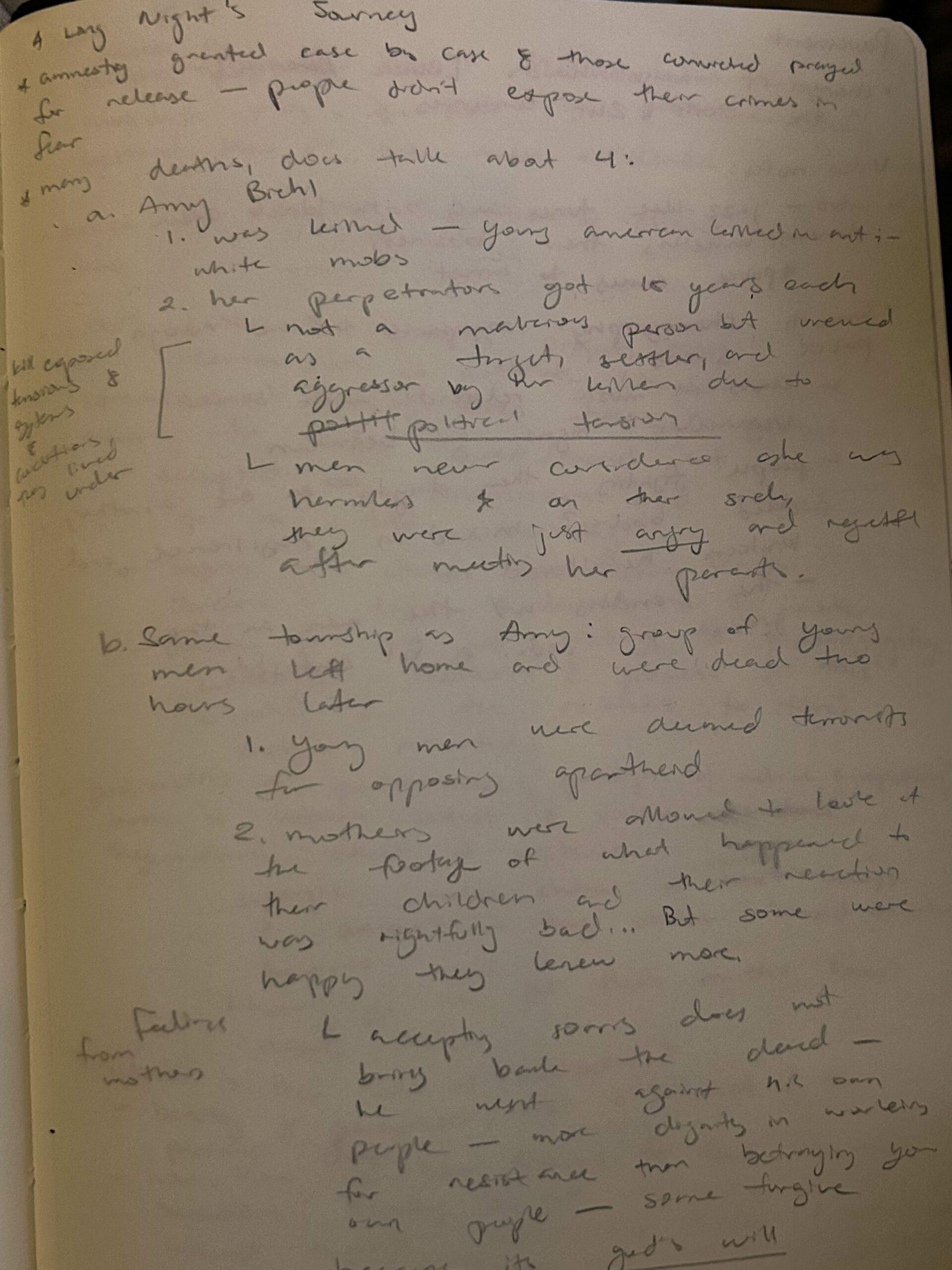
When I first learned about the ‘A Long Night’s Journey’ documentary, I had no idea what to expect of the four examples of amnesty from the TRC after the apartheid. After finishing the documentary, I felt a weight on my chest and nauseous from crying. This documentary didn’t shy away from showing the reality of the TRC amnesty plans and the reality of why people asked for amnesty. The very first account, Amy Biehl’s, made me realize that it wasn’t just the killing of Black South Africans that they were forgiving. When initially going into the documentary, while not knowing what to expect, I believed it would only be atrocities towards Black South Africans. However, Amy Biehl’s was still a loss and murder, and it held so much weight to it. She was an advocate for the apartheid to end, however, to the young men who were fed up with the tyranny, it didn’t matter. She was another white woman. It put into perspective how violence and suppression of the people will lead to violent retaliation. The next account that I wrote notes on was the very last account, the one with the South African man who ended up firing on his own people. The reason that account stuck with me the most was because of how the mothers of the young boys reacted to him asking for amnesty. They felt incredibly betrayed to find out another South African man had been working with the nationalist political party. However, many of the mothers felt relief knowing who did it, and some even forgave him under god’s will. This documentary challenged the way I view grief and culpability. Cultural memory plays a huge part in healing a country after traumatizing events, and the TRC took a new approach to healing and forgiving
Scholarly Argument – Ideal Theory as Ideology
Charles W. Mills’ in Ideal Theory as Ideology breaks down the ideas that’re considered to be normative through his quote “empiriciam will not work as a cognitive strategy” [175]. Simple empiricism means trusting knowledge that comes to our brain immediately as the truth without considering where it comes from. Mills explains that many concepts or habits that may be in our life cannot simply be dismissed as obvious or natural, we must realize that they come from “social structures” and patterns rooted in our reality [175]. He connects the idea of knowledge being rooted in the way we live and grew up as a way to elaborate on his greater critique of philosophers’ blindspots. Nozick and Rawls’ theories are critiqued to demonstrate how a lot of their ideas are revolutionary, but are not rooted in reality. They never mention how their ideas affect people of color, the poor, women, or minorities.

Philosophical Premise – A Theory of Justice
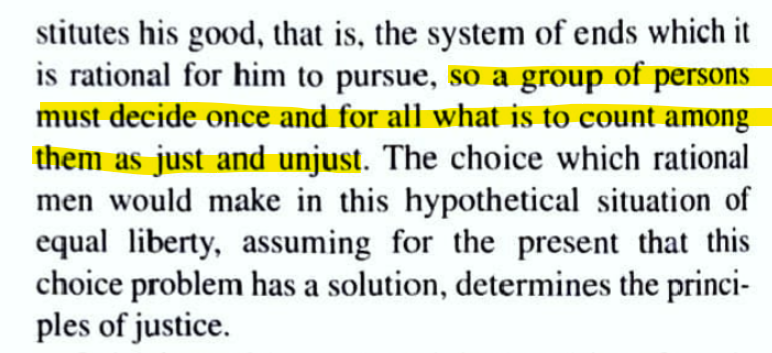
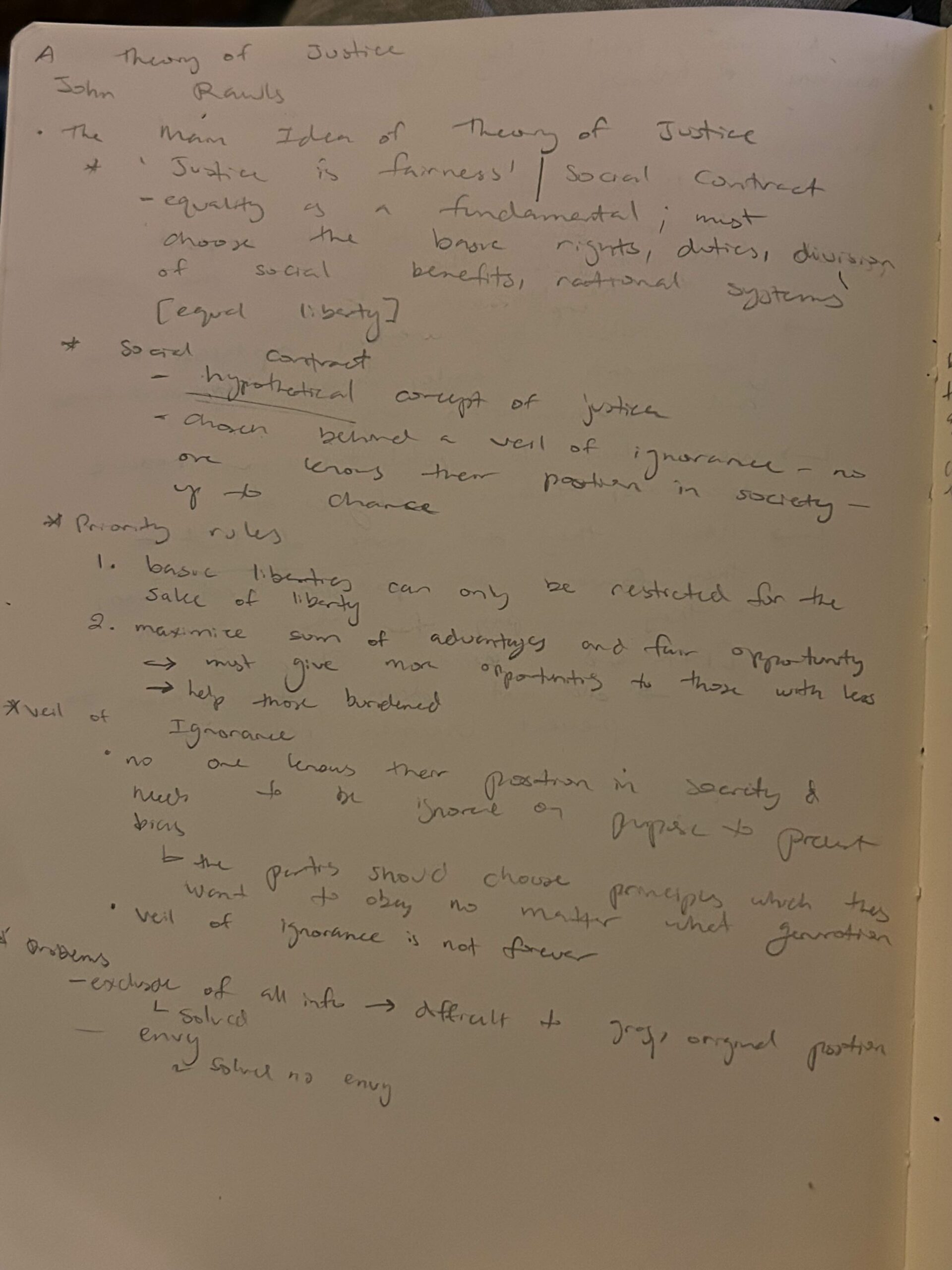
John Rawls, on page 720 of ‘A Theory of Justice,’ elaborates on the fundamental groundwork of his theory. In this particular annotation, I focused on the quote “a group of persons must decide once and for all what is to count among them as just and unjust.” Rawls’ theory draws upon John Locke’s ideology of the “social constract” where rational individuals decide their own rules together for a “just” society. Rawls’ theory is purely hypothetical, drawing upon individuals creating a society for themselves behind the veil of ignorance. The veil of ignorance serves to completely block people from thinking about their class status or identity, just how their lived experiences would be affected by the rules they create. I had a few questions, such as if it means that oppression never existed since this is the “original position.” And how it is affected after the veil of ignorance drops. Rawls debunks the idea of oppression existing after the veil of ignorance drops, seeing as the veil of ignorance would block ideas of oppression for the thinkers own convenience.
Poetic Response – Dante’s Inferno
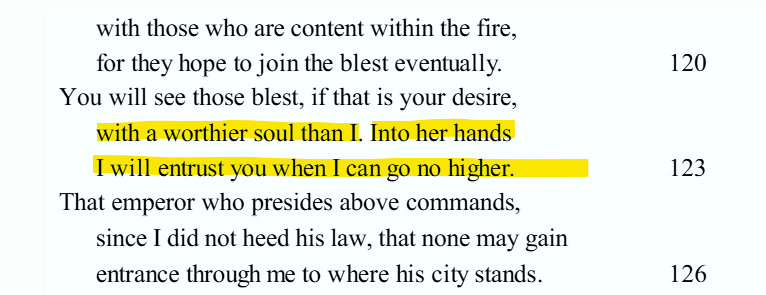
Dante’s Inferno, translated by Michael Palma, referenced Beatrice in the quote “you will see those blest.. with a worthier soul than I. Into her hands I will entrust you when I can go no higher” in Canto I, line 122. When initially reading about Beatrice, I did not know how deeply it went into Dante’s own lived experience. Based on the class notes of September 9th, led by Dr. Wills, Beatrice was the love of Dante’s life. When writing about justice, Dante wrote about public figures, people in his life, ongoing history, and Greek mythology to convey his interpretation of the hell circles. He took control of deciding who deserved hell and who deserved to go to paradise. Beatrice, the love of his life, was always deemed “worthy” of paradise, hence why he wrote about her, interrupting his path and leading him to paradise. Dante utilized his own lived experience to express judgment of those in his narrative.
Historical Analysis – The Nuremberg Trial: Fifty Years Later
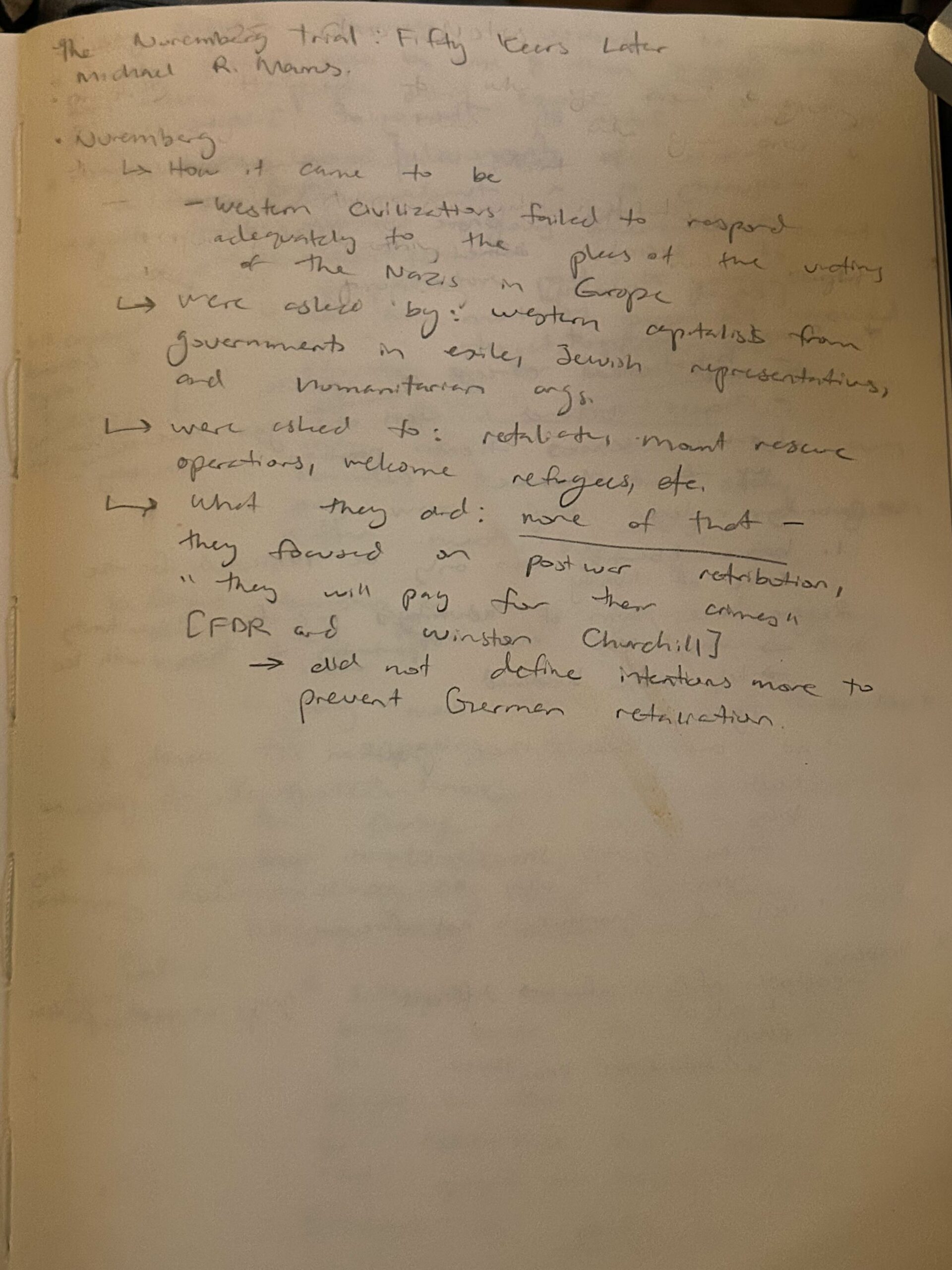
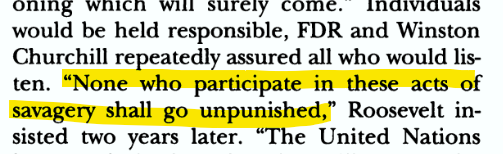
Michael R. Marrus, in The Nuremberg Trial: Fifty Years Later, elaborated on Franklin D. Roosevelt, insisting “None who participates in these acts of savagery will go unpunished” about the Nazis post-WW2 [563]. The article focused on how WW2 was a product of its time; however, this particular quote stood out. It was amidst an elaboration of how President FDR and Western civilizations failed to adhere to the wants of Western capitals from governments in exile, Jewish representatives, and humanitarian organizations [563]. They asked for Western civilizations to accept refugees, retaliate, and create rescue operations [563]. However, none of these were done due to the punitive approach of FDR and Winston Churchill, as they focused on punishing Nazis instead of addressing the inequalities and systems that platformed the Nazis.
SPRING
Non-Textual Visual Artifact – A Subtlety, Kara Walker
During Dr. Corso’s lecture, an artwork that caught my attention was Subtlety by Kara Walker. It’s a large piece depicting an antebellum caricature of an enslaved woman in a suggestive position on all fours, chest exposed and nude, bent forward with her bottom half in the air. What shocked me the most from this piece was the fact that it was entirely made of sugar, representing the sugar made in the sugar plantations. The sexual imagery and position allude to rape as we mentioned in class, and people who take selfies further demonstrate the sexualization of the enslaved when it’s considered “okay” to do so. No one said they’re not allowed to take images, but considering the weight that is added to the piece, I’m unsure whether it would be appropriate to do so. It reminds me of the text about civil contract, and the viewers responsibility to take in images appropriately when they communicate atrocities. Overall I was very impressed with this piece and it’s ability to communicate a resistance of submission by “flipping the bird,” her head held high in contrast to her position, and the dark light shining on her as an act of visibility.
Article/Chapter Presenting a Scholarly Argument – Docile Bodies
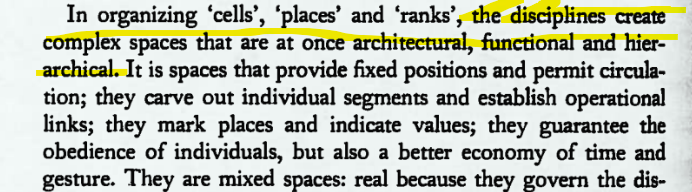
Michel Foucault describes the usage of space as a method of oppression, and that those deemed “unruly” get separated from those deemed “clean” (147). This hierarchical method is possible through the creation of cells, places, and ranks, and they further push the subordination of the unruly through isolation (148). The idea is drawn upon from the Panopticon model, but it spreads way beyond prisons and into schools, public spaces, jobs, and more. All spaces create hierarchies to force subordination and monitor all individuals while taking away their ability to function on their own (147). Their bodily movements, social expression, and thoughts are taken to be used in favor of Capitalism.
Response to a Performance/Performance-Based Practice – Dancing to the Promised Land
When watching Dancing to the Promised Land, I focused a lot on the way everyone in the performance moved their bodies according to the historical lens they were trying to convey. Though all dancers were gentle with one another, they had to be firm and strong to recreate the violence against marginalized communities in art form, especially the black community. Bill T. Jones talks about his mother’s account of something that happened around the Civil Rights movement in Little Rock Arkansas, where a farmer and the black man who worked for him had a close relationship, but once the black man offended the farmer, he committed great acts of violence towards the black man and his sons. Learning about this encounter, I can’t imagine what it would be like to be a dancer, having to embody these types of stories and perform them in an accurate manner. Having to perform the hierarchies and the mass amounts of violence that was enacted on them, mixes historical suffering with art. But Bill T. Jones mixes these memories with his depiction of the whipping of Uncle Tom, from Uncle Tom’s cabin, something I found to be interesting and powerful.
Article/Text Presenting Historical Analysis/Documentation – Stop the Church and Choreographies of Protest
At the beginning of Stop the Church, many different older individuals were interviewed about their thoughts on the St. Patrick’s Roman Catholic Cathedral in 1989. Something I found interesting were the different opinions of the church and how they played into the planning of the die-ins by ACT UP during the service. Arguably, this 30-minute documentary conveys an anti-catholic narrative due to their judgement against AIDS survivors and homosexual individuals as a whole. The woman at the beginning, who had a positive view of the church as a welcoming space with no judgment, was continuously debunked by all other opinions of those interviewed. The die-in was performed in this church because of its isolation and ignorance of AIDS survivors, directly contradicting any notion that the Catholic church during 1989 welcomed all. The song behind the montage of clips from the church is dedicated to mocking the rituals of the church, like “there’s the guy who is religious, he’ll tell you if your sins are original, if it is, try playing it safe and drink the wine and chew the wafer.” There’s a clear notion that the church at the time was not functional for the people, as seen by ACT UP’s planned protests in Choreographies of Protest and this documentary.
Article/Chapter Presenting or Discussing a Legal Argument
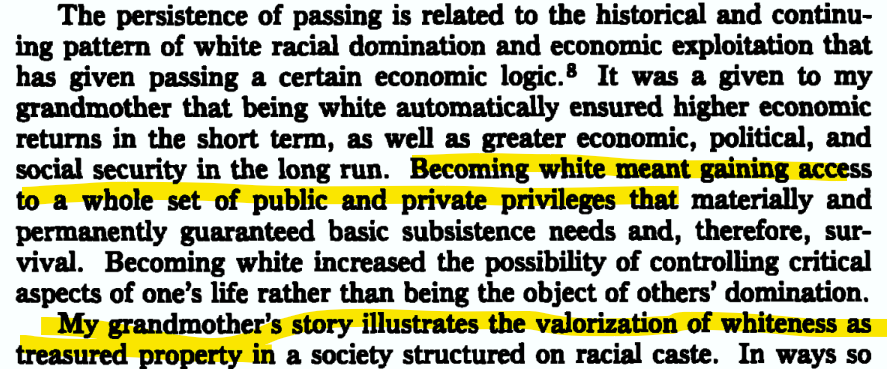
Upon first reading the sentence, “it was not the concept of race alone, but the interaction between concepts of race and property” that worked to oppress Black individuals and Native Americans, I was extremely confused (1716). I hadn’t understood how the idea of property and race worked together, under the following sentence about the black enslaved who were treated as property (1716). In this, I can see how it wasn’t just the fact that they were black, but that they were both black and deemed non-human. In this sense, the opposite, the protection of whiteness as property, grants the white race a power that other races aren’t granted. The law protects white individuals as if they were valuable property, and it’s directly in contrast to the dehumanization of black and native american individuals.